Guide 01
A beginner’s history of AI
Published 26 August 2026
AI did not begin with ChatGPT. This guide follows the turning points — what happened, and why it mattered — without the mathematics.
AI did not begin with ChatGPT
For many people, artificial intelligence seemed to arrive overnight. One day AI was something from science fiction. The next, people were asking chatbots to explain homework, write code, create pictures and plan their week.
But AI did not suddenly appear in 2022. Its history stretches back through decades of experiments, bold predictions, useful inventions and expensive disappointments.
This guide follows the turning points without burying you in mathematics. You do not need to understand coding. For each moment, we will answer two questions:
- What happened?
- Why did it matter?
One thing to keep in mind: AI is not a single machine or a single method. It is a broad field covering many attempts to make computers perform tasks connected with perception, language, learning, reasoning and action. The meaning has shifted as the technology has changed.
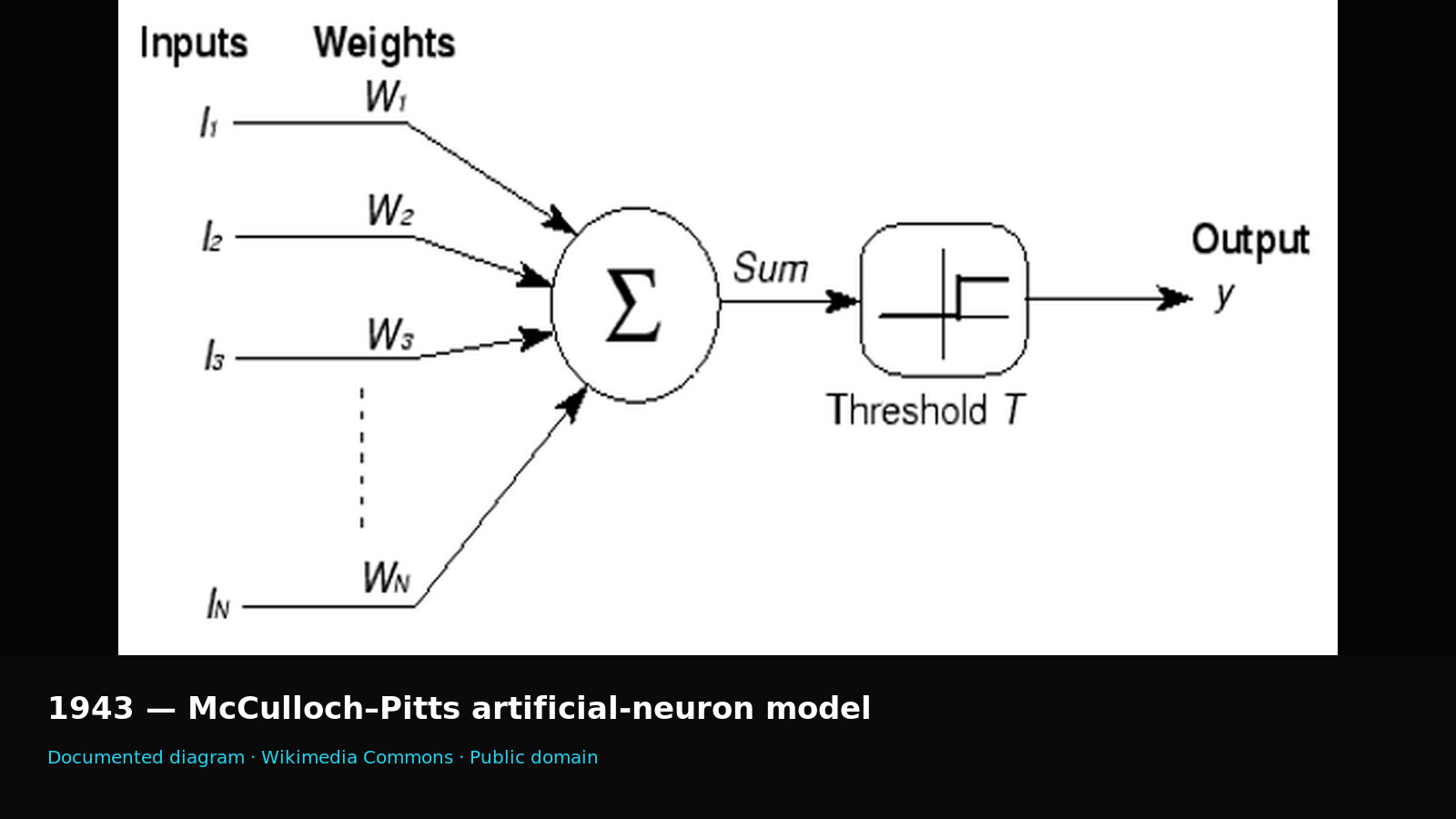
1943: researchers turn a neuron into mathematics
Warren McCulloch and Walter Pitts published a paper that described a highly simplified mathematical model of a neuron. Their artificial neurons could switch on or off, and networks of them could represent logical operations.[18]
This was not a working brain inside a computer. Real neurons are far more complicated, and the authors were working with mathematical abstractions. Even so, the paper joined three ideas that would stay together throughout AI history: brains, logic and computation.
Why did it matter?
It showed that at least some brain-like activity could be described as a system of simple units and rules. That idea became one of the roots of neural networks.
In plain English: perhaps complicated behaviour can grow from many simple parts working together.
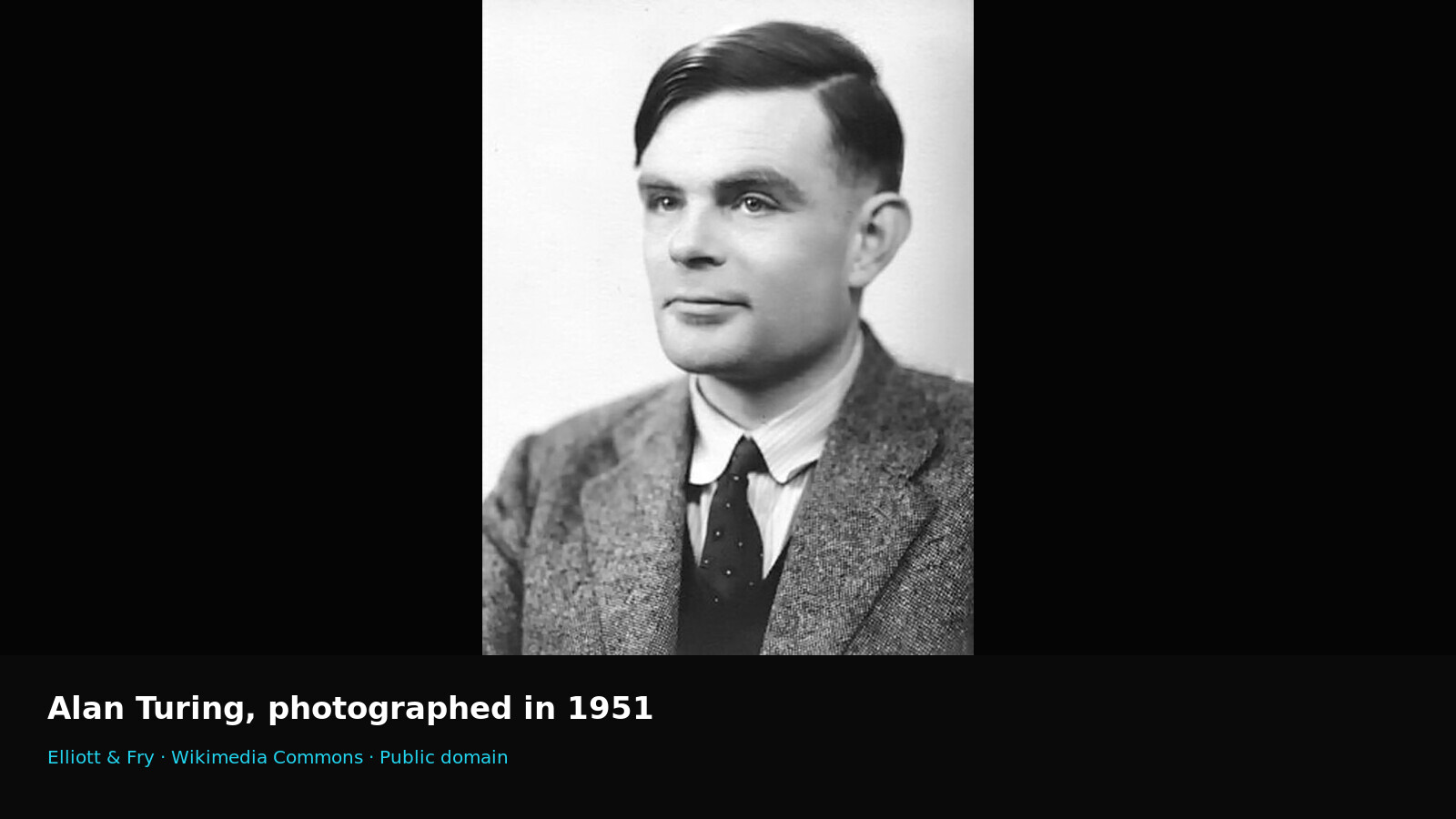
1950: Alan Turing asks a difficult question
In 1950, British mathematician Alan Turing published Computing Machinery and Intelligence. It opened with a question that still matters:
“Can machines think?”
Turing argued that arguing over the ordinary meanings of machine and think would not settle the issue. He replaced the question with a more precise game.
His original imitation game involved a man, a woman and a separate interrogator. The interrogator received written or typewritten answers and tried to identify the two people. Turing then asked what would happen if a machine took the man’s place: would the interrogator make the wrong identification as often as before?[1]
Later, simpler versions of this idea became known as the Turing Test.
Why did it matter?
Turing did not build today’s AI. His imitation game measured visible conversational behaviour; passing it would not, by itself, prove consciousness or inner understanding.
What he did was give people a practical way to discuss machine intelligence. Instead of arguing forever about what “thinking” meant, they could examine what a machine could do.
In plain English: can a machine’s written answers make it difficult for someone to distinguish it from a person?
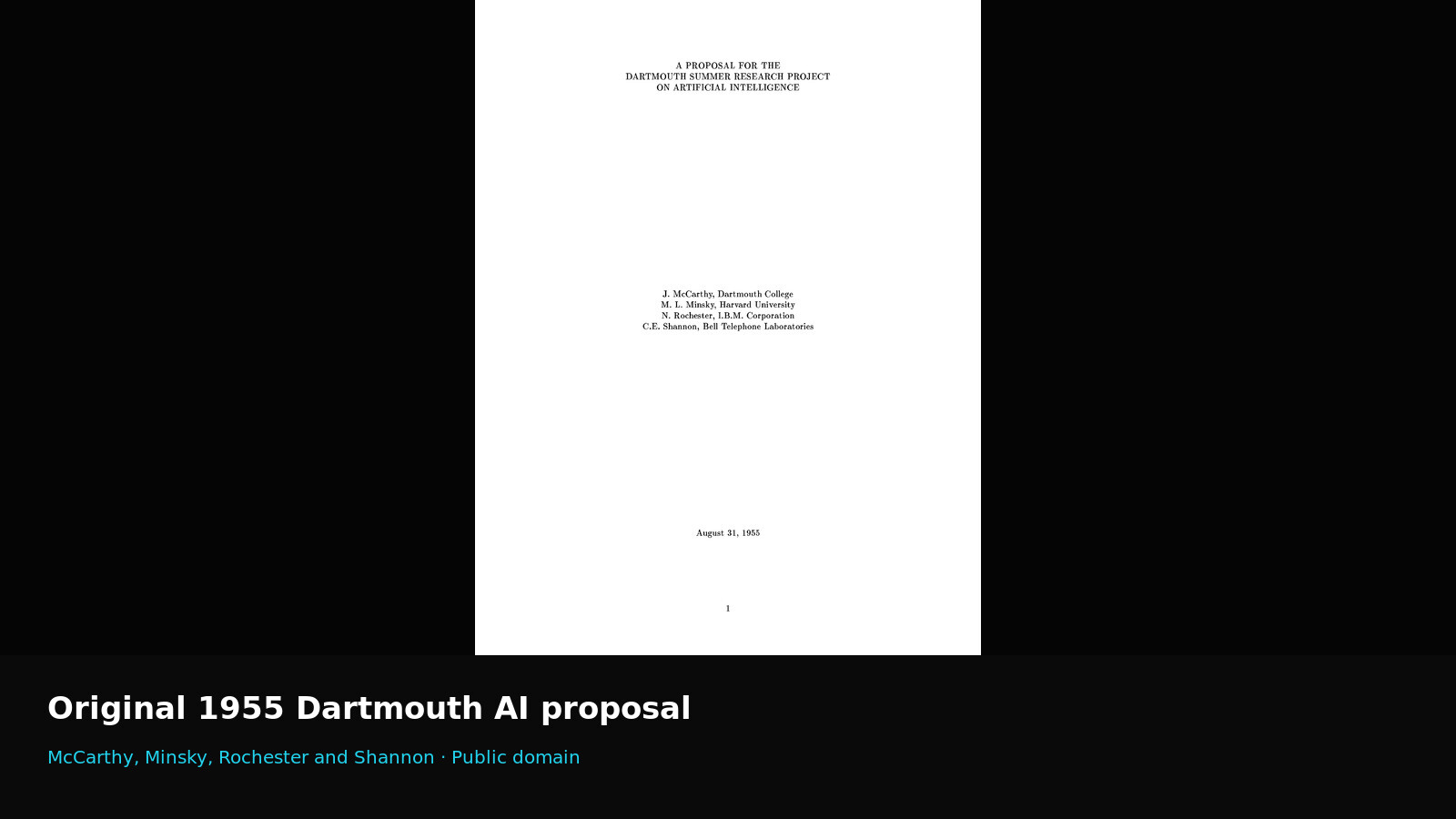
1955–1956: artificial intelligence gets a name
On 31 August 1955, John McCarthy, Marvin Minsky, Nathaniel Rochester and Claude Shannon proposed a summer research project at Dartmouth College.
Their plan was for a small group to spend the summer of 1956 investigating whether machines could use language, form concepts, solve problems and improve themselves.[2]
The proposal used the name artificial intelligence. John McCarthy is credited with introducing the phrase. The 1956 project helped establish AI as a recognisable research field, although work on machine intelligence had begun earlier.[2][4]
The organisers were optimistic. They wrote that “a significant advance” could be made in one or more of these problems if a carefully selected group worked together for one summer.[2]
The project did not produce the breakthrough McCarthy hoped for. Looking back, he said he had wanted a breakthrough towards human-level AI, but none occurred.[3]
Why did it matter?
Dartmouth gave a scattered set of questions a shared name. Researchers could now gather around a field called artificial intelligence, seek funding for it and argue about how it should work.
It also established a pattern that AI would repeat: serious progress mixed with an underestimate of how difficult intelligence would be to reproduce.
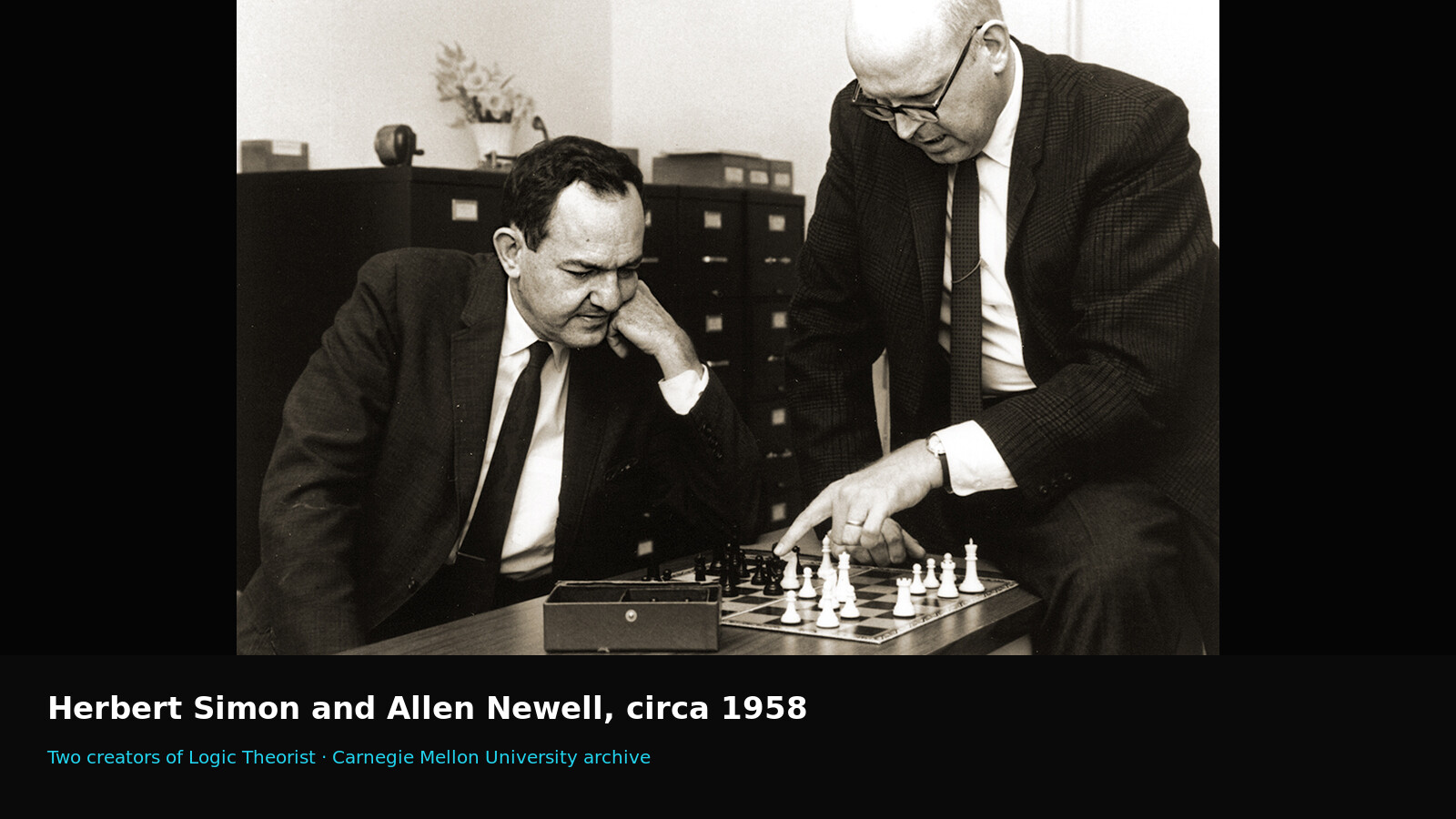
1955–1956: computers begin proving theorems
Around the same period, Allen Newell, Herbert A. Simon and J. C. Shaw developed Logic Theorist. The program proved theorems from Principia Mathematica, a major work of formal logic. It used search methods and shortcuts known as heuristics rather than checking every possibility blindly.[19]
This approach became known as symbolic AI. A programmer represented knowledge with symbols and rules, then the computer manipulated those symbols to reach an answer.
Why did it matter?
Logic Theorist showed that a computer could do more than arithmetic. It could perform a limited form of reasoning inside a carefully defined world.
The limitation matters. The program worked because its world had clear rules. Everyday life is full of ambiguity, missing information and exceptions. Symbolic systems were impressive in controlled settings but often struggled when the real world became messy.
In plain English: write down the knowledge and rules, then let the computer search for a valid answer.
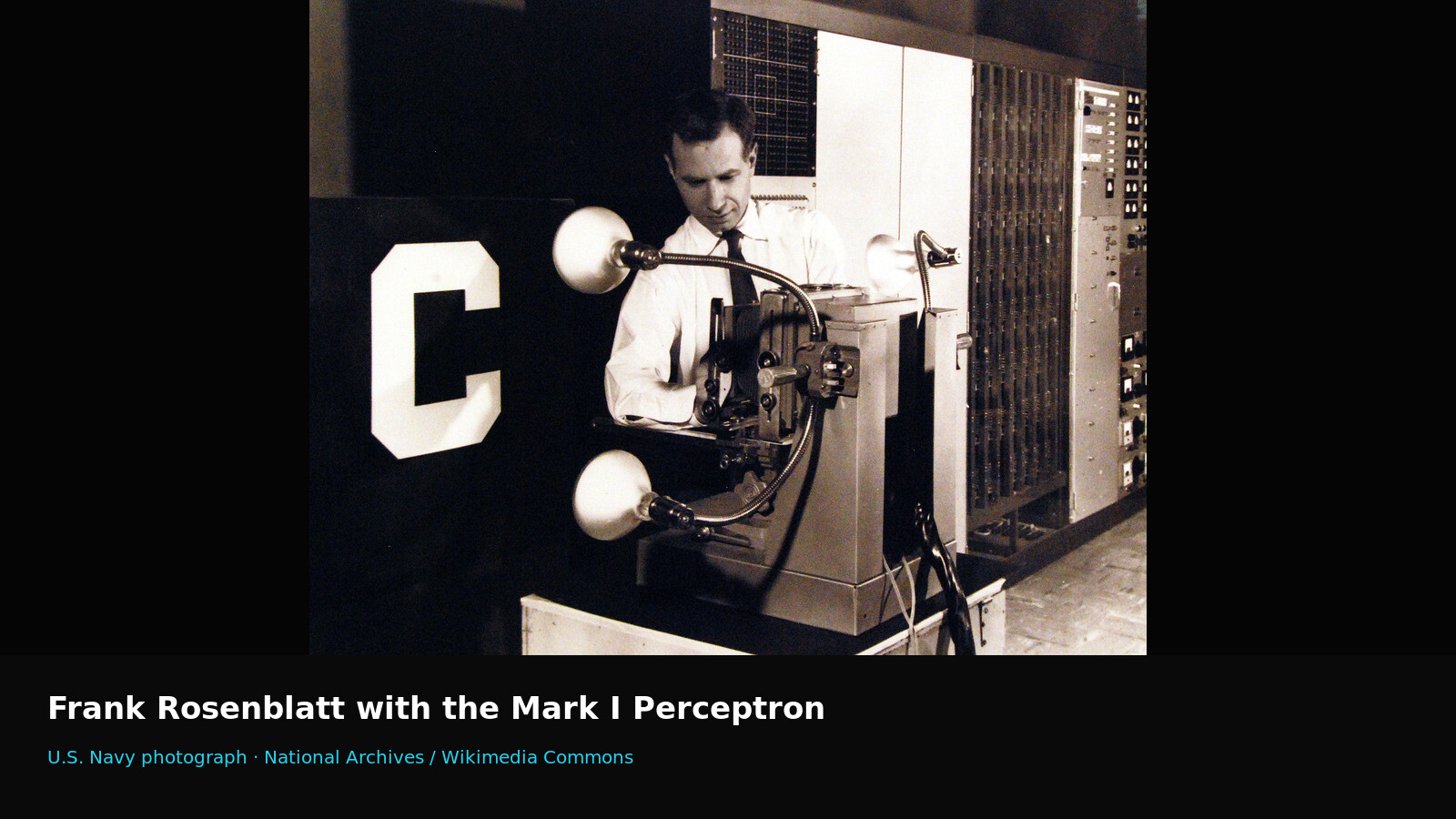
1957–1958: the perceptron learns from examples
Frank Rosenblatt described a neural network called the perceptron in 1957. By the following year, his Cornell Aeronautical Laboratory team had constructed the Mark I Perceptron, an electronic system designed to learn associations for perception and memory.[20]
This was a different route from symbolic AI. Instead of giving the computer every rule, researchers adjusted the strengths of connections so the system could learn a decision from examples.
Public claims raced ahead of the machine’s actual abilities. A single-layer perceptron could only learn certain kinds of patterns. It was not an early ChatGPT, and it did not understand the objects it classified.
Why did it matter?
The perceptron made a powerful idea concrete: a machine might learn its own useful rules from data instead of receiving every rule from a programmer.
That basic divide still runs through AI. Do we write the knowledge into the system, or do we let the system learn patterns from examples?
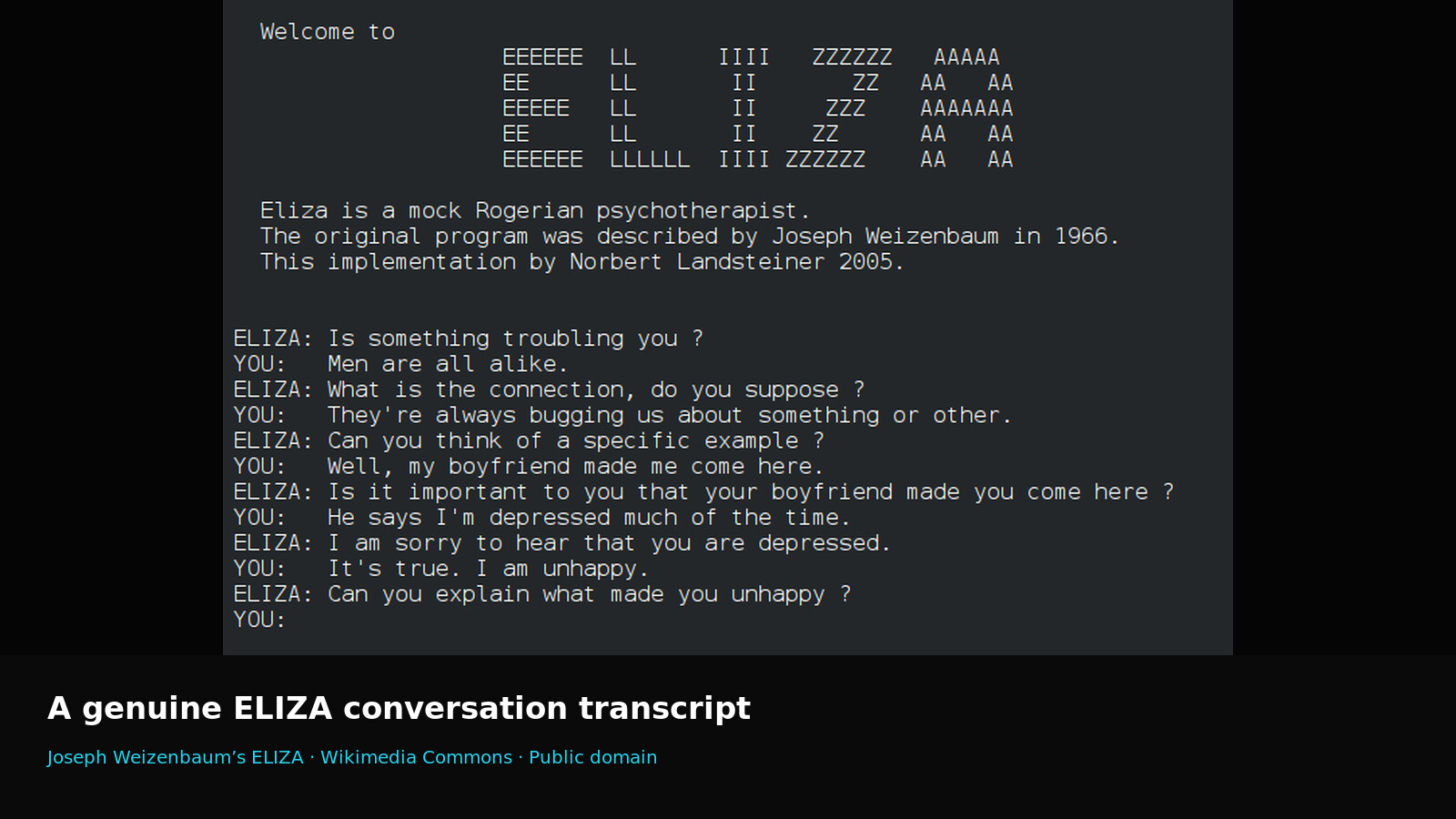
1966: ELIZA shows how easily we read meaning into a machine
Joseph Weizenbaum created ELIZA, a program that could hold a text conversation by matching patterns in a user’s words and transforming them into replies. Its best-known script, DOCTOR, imitated a non-directive psychotherapist.[21]
ELIZA did not understand a person’s feelings. It used relatively simple rules to keep the conversation moving. Yet some users still felt that the program understood them.
Why did it matter?
ELIZA was an early warning about the gap between how a system works and how it feels to use.
People naturally supply meaning, personality and intention when a machine produces a convincing reply. Modern chatbots are vastly more capable than ELIZA, but the human tendency remains.
A fluent answer can feel like understanding. The two are not automatically the same.
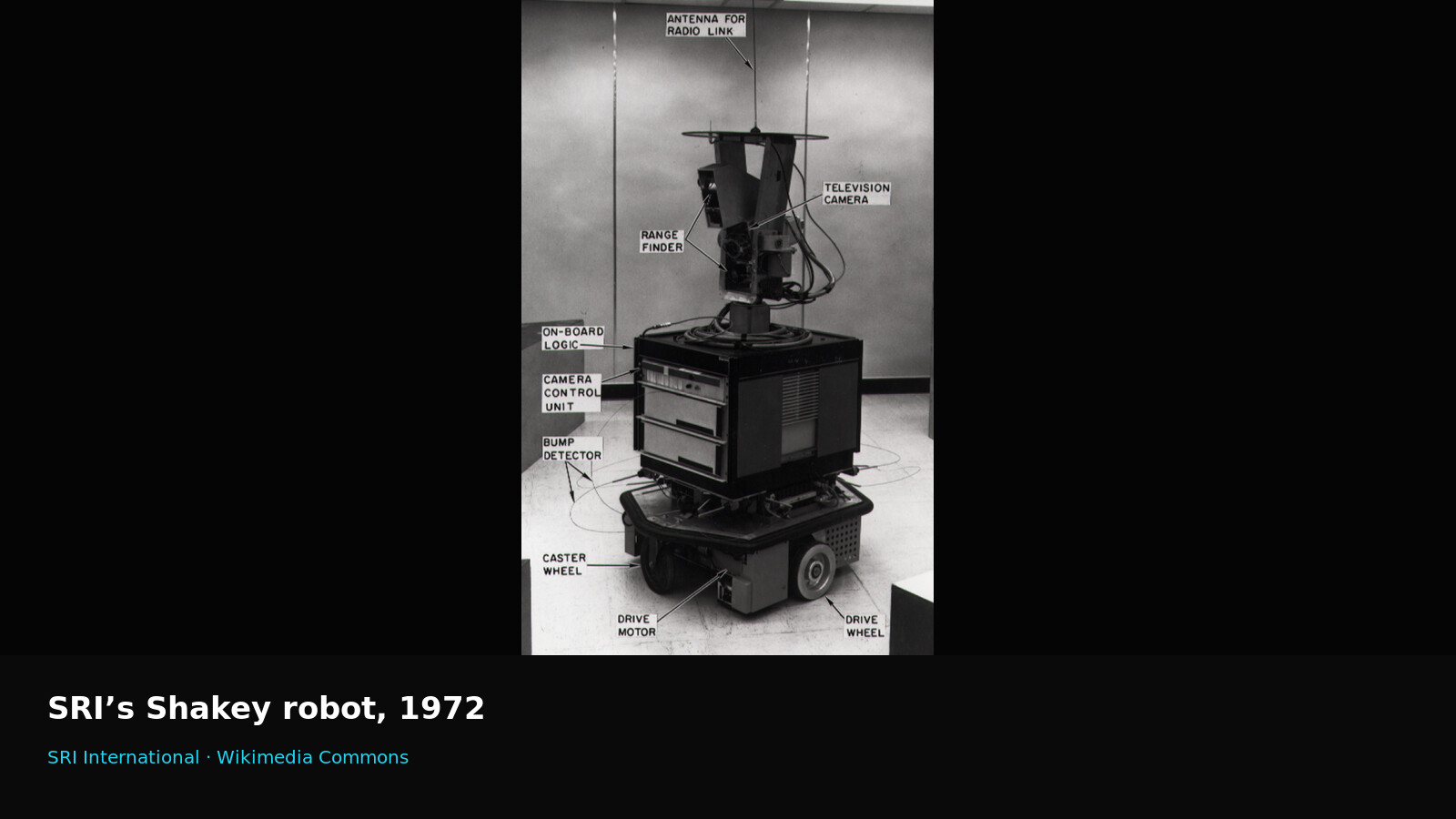
1966–1972: Shakey connects reasoning to the physical world
SRI International developed Shakey, a mobile robot that could perceive and reason about its surroundings. It could plan routes and move simple objects in a controlled environment.[5]
Shakey was slow and depended on a remote computer. It did not wander freely through a normal home. But it connected several AI problems in one system: vision, planning, navigation and action.
Why did it matter?
A program proving a theorem only has to manipulate symbols. A robot must also deal with space, objects and the consequences of its actions.
Shakey helped lay foundations for robotics and automated planning. It also exposed how much harder intelligence becomes when a machine has to operate outside a neat digital puzzle.
The 1970s: the first AI winter
Early successes produced big expectations. Researchers had made programs that could prove theorems, play games, process limited language and navigate controlled rooms. The next leap looked closer than it really was.
Then the weaknesses became harder to ignore. Systems that worked in small demonstrations often failed when the number of possible choices exploded or when the task moved outside a narrow setting.
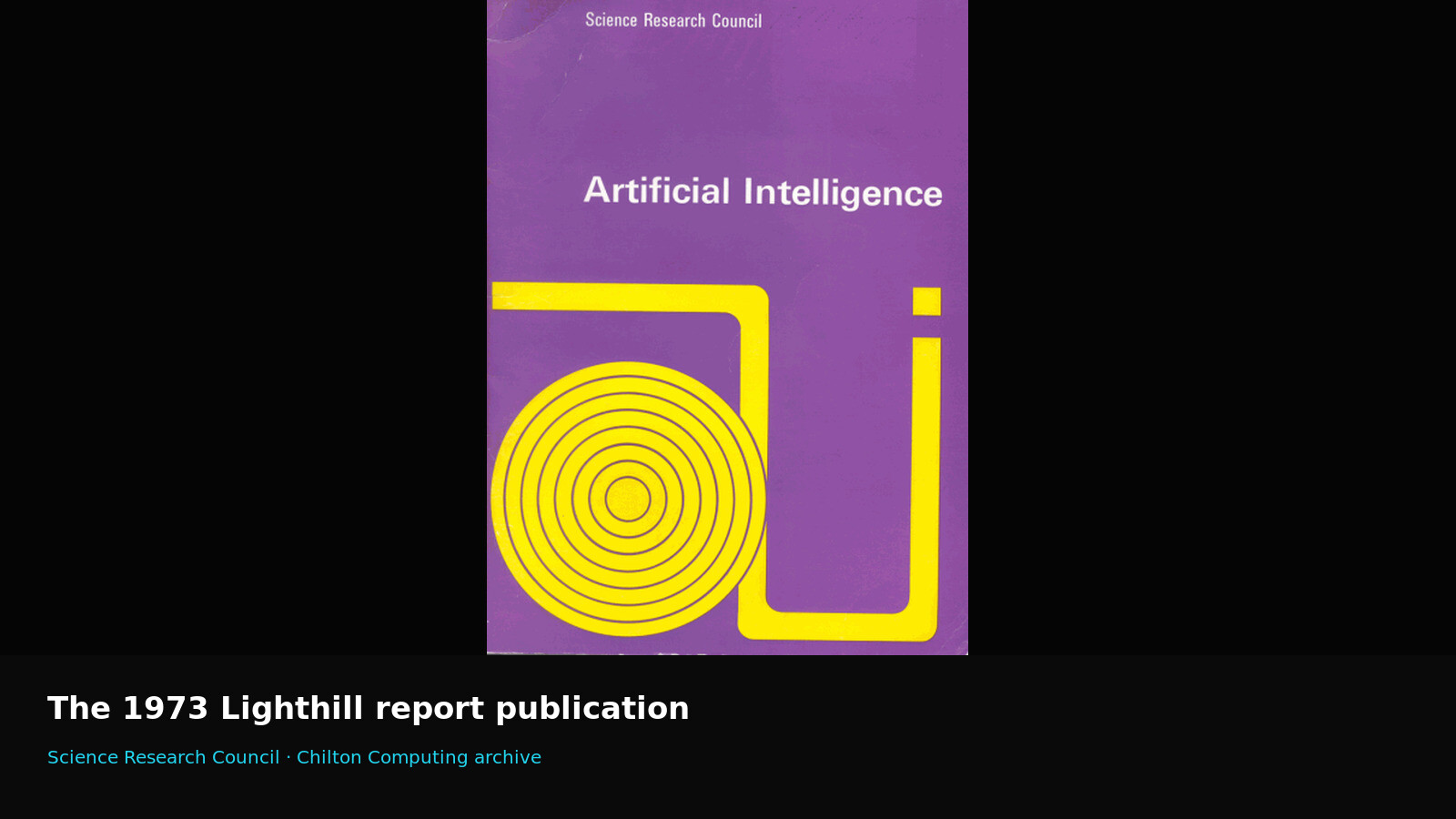
James Lighthill’s 1973 report for Britain’s Science Research Council criticised the lack of progress towards AI’s larger goals and argued that many methods did not scale well.[6] Funding and confidence fell. Historians often call the wider period of reduced enthusiasm the first AI winter, although it did not begin everywhere on one exact date and the Lighthill report was mainly a British event.[7]
Why did it matter?
This was the first clear lesson that a convincing demonstration is not the same as a reliable general system.
AI had not died. Research continued, and useful ideas survived. The winter meant that money, jobs and public excitement became harder to find.
The phrase “AI winter” describes a collapse in confidence and funding, not a total stop to AI research.
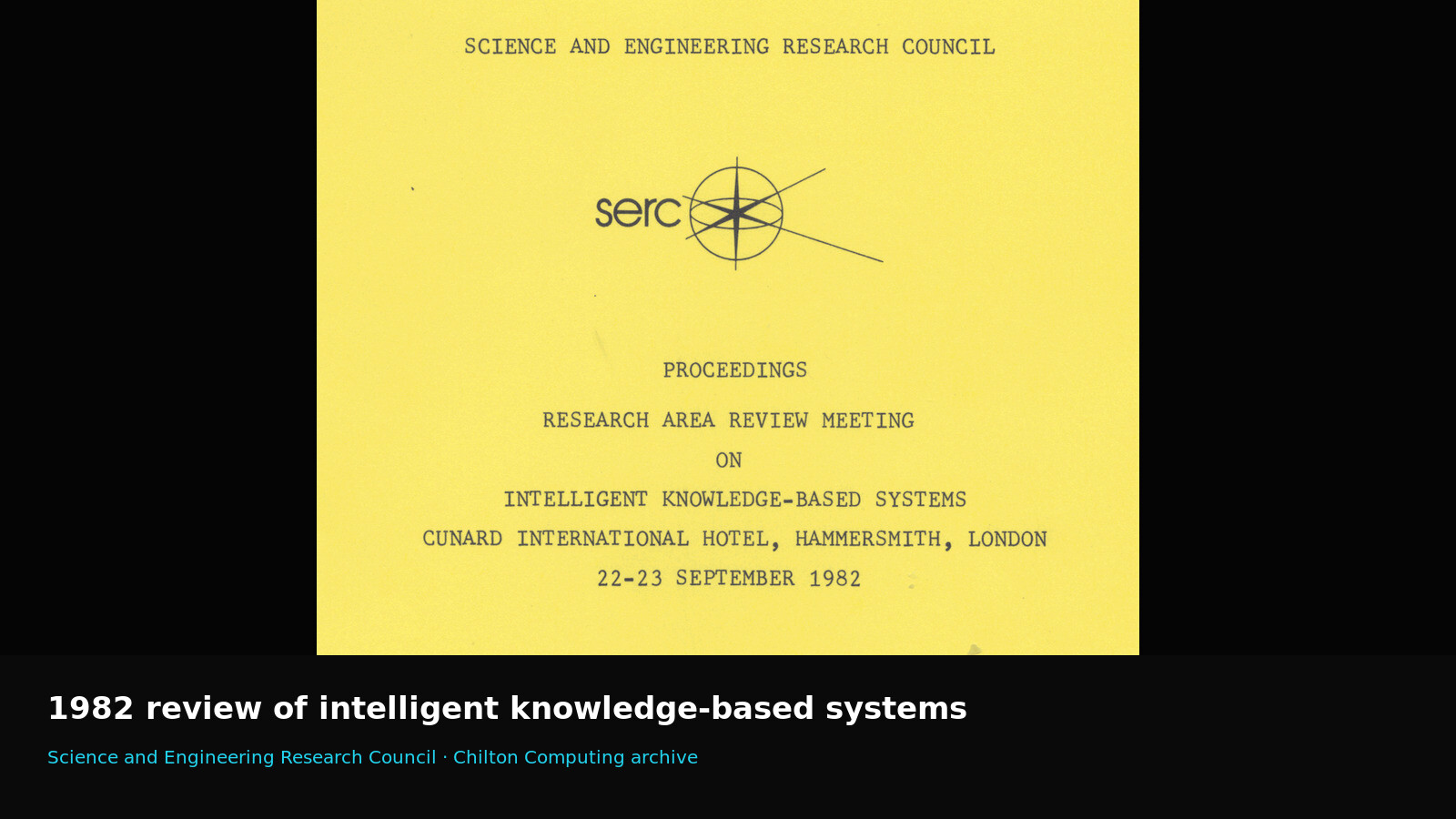
The 1980s: expert systems bring AI into business
AI returned to favour through expert systems. These programs stored specialist knowledge as rules and used an inference engine to apply those rules to a particular case.
Systems were built for tasks such as configuring computers, analysing chemicals and supporting medical decisions. Companies invested heavily because expert systems promised to capture scarce human knowledge and use it consistently.[7]
They worked best in narrow, stable areas. Building and maintaining the rule base was expensive. The systems could be brittle when a case sat outside the knowledge they had been given, and they did not automatically gain everyday common sense.[7]
Why did it matter?
Expert systems proved that AI could create practical value without reproducing a whole human mind.
They also showed the cost of hand-written intelligence. If every important exception must be collected from an expert and converted into a rule, the system becomes difficult to expand and maintain.
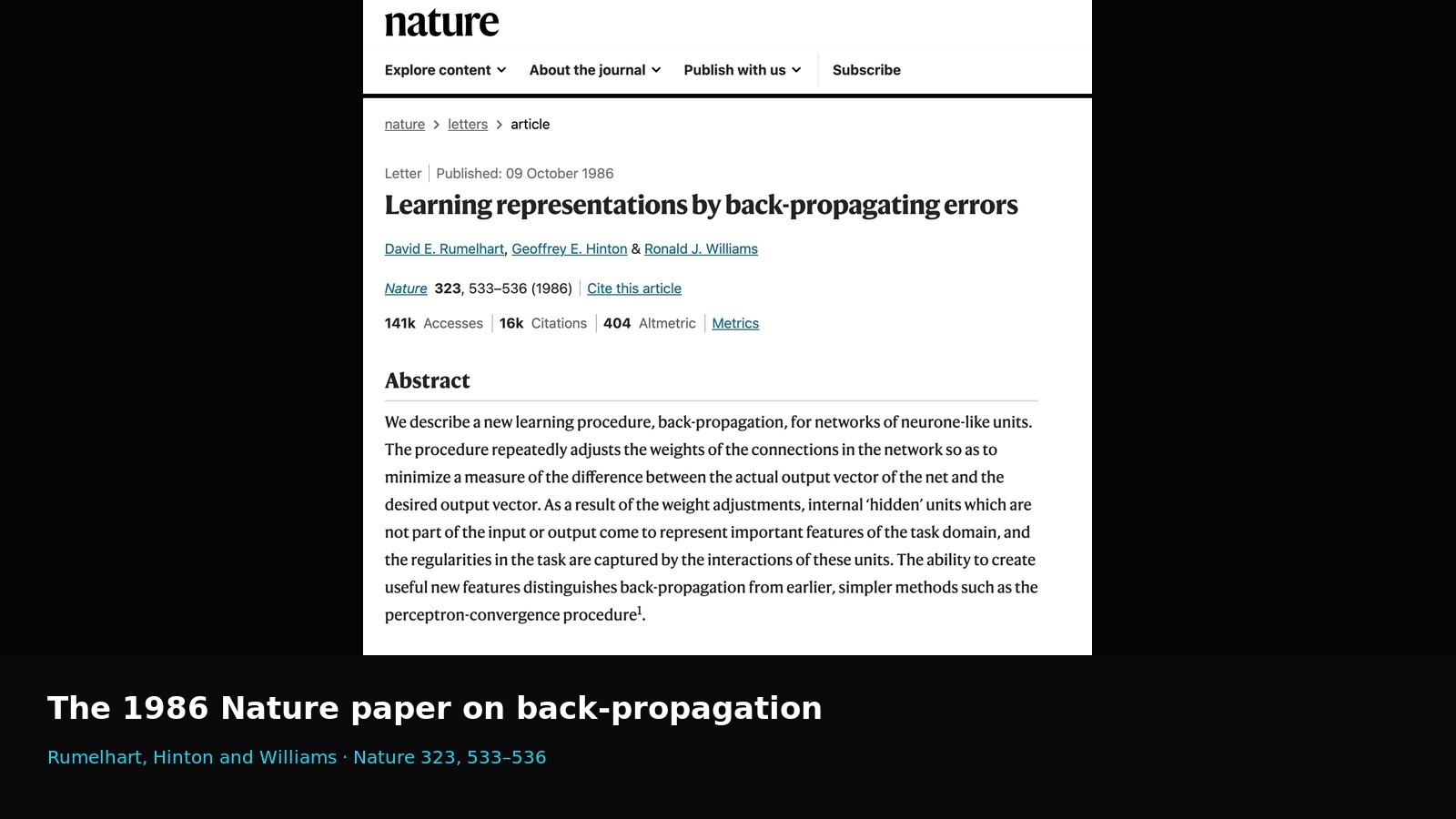
1986: neural networks learn useful internal features
David Rumelhart, Geoffrey Hinton and Ronald Williams published an influential description of training multi-layer neural networks with back-propagation. The method repeatedly adjusted connections to reduce the difference between the network’s output and the desired answer. Hidden layers could learn useful internal features of a task.[8]
The 1986 paper helped revive interest in neural networks, but it did not invent every part of back-propagation from nothing. Earlier researchers had developed related ideas. Its importance came from explaining and demonstrating the method clearly at a moment when neural networks needed a convincing route forward.
Why did it matter?
A multi-layer network could learn intermediate representations rather than relying only on features chosen by a programmer.
The idea was powerful, but the hardware and datasets of the 1980s limited what researchers could train. The method would become far more important once computers became faster and large digital datasets became available.
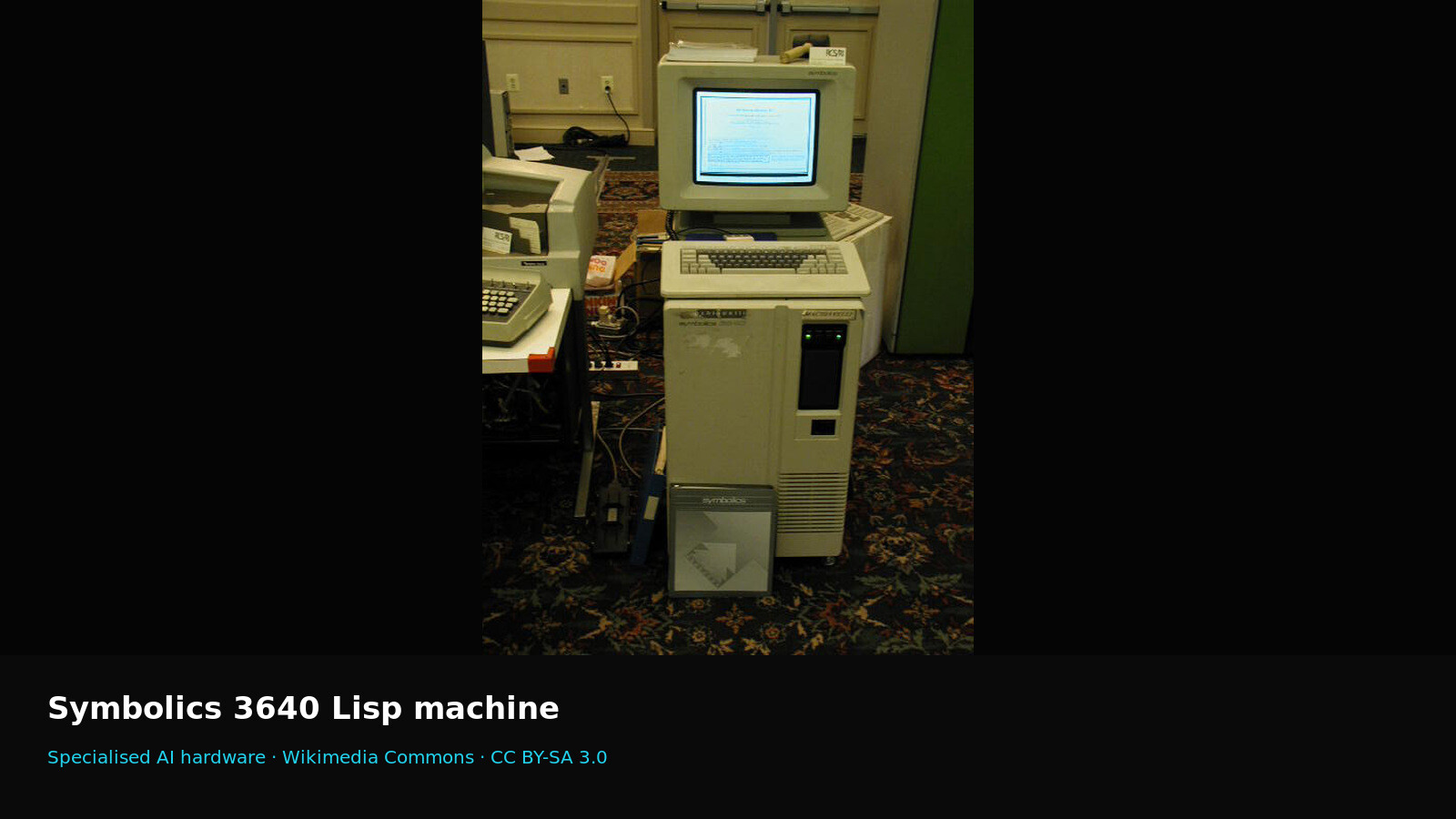
The late 1980s and early 1990s: a second winter
The expert-systems market weakened. Specialised AI computers lost out to cheaper general-purpose machines, while companies discovered that expert systems were costly, narrow and difficult to maintain.[7]
Funding and commercial interest fell again. This period is commonly called the second AI winter.
Why did it matter?
The underlying work did not vanish. Researchers kept developing machine learning, probability-based methods, speech systems, computer vision and neural networks, often without putting the fashionable AI label on everything.
AI history is not a clean line from failure to success. Methods can disappear from public attention while the slow technical work continues underneath.
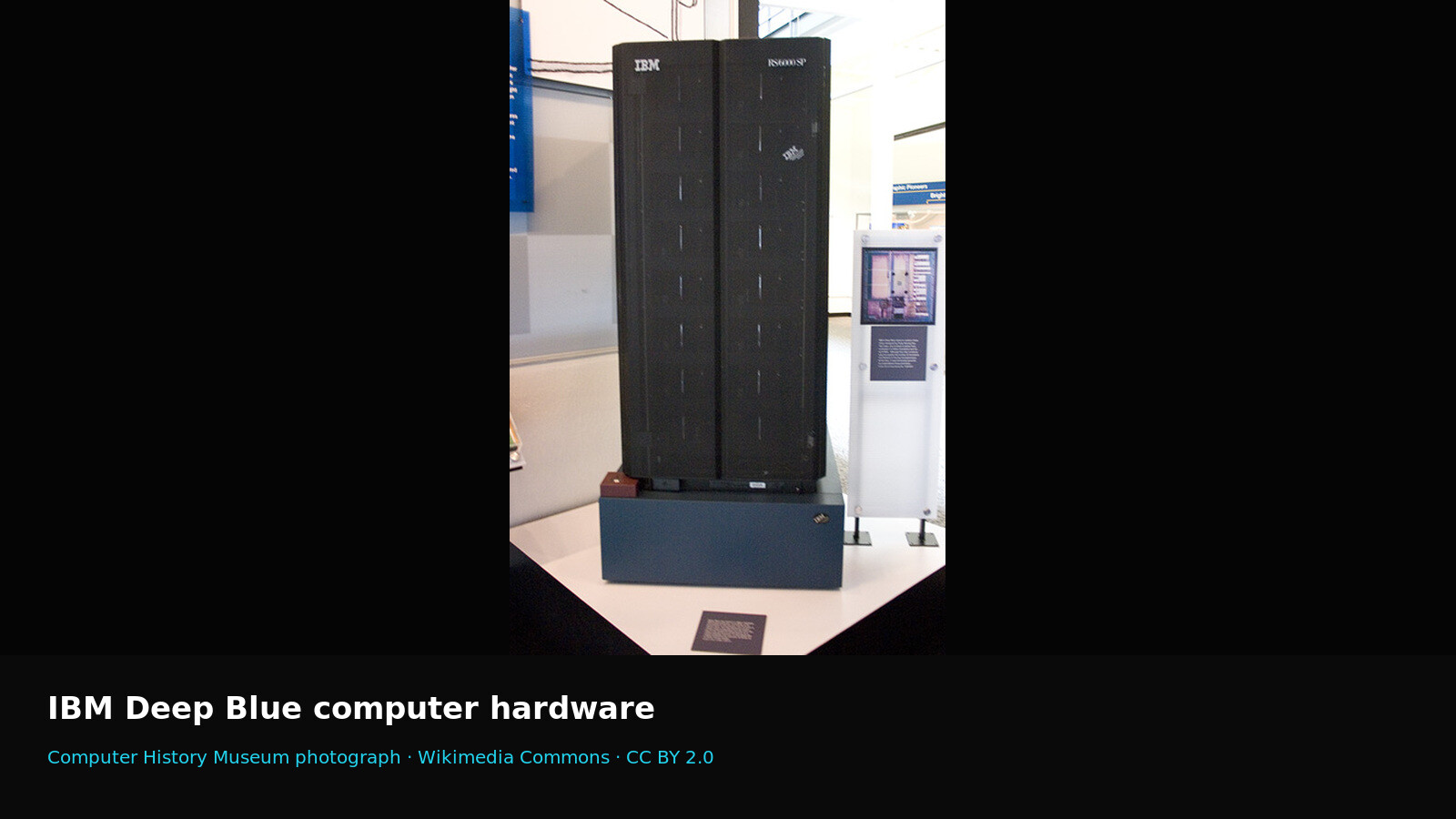
1997: Deep Blue defeats the world chess champion
In May 1997, IBM’s Deep Blue defeated reigning world chess champion Garry Kasparov in a six-game match under standard tournament time controls.[9]
Deep Blue evaluated as many as 200 million chess positions per second. It combined immense computing power with chess search, evaluation methods, databases and knowledge supplied by its human team.[9]
It was brilliant at chess. It could not hold a normal conversation, drive a car or transfer its skill to another board game.
Why did it matter?
The match gave the public a clear image of a machine outperforming a top human in a prestigious intellectual task.
It also exposed a point that still causes confusion: a machine can exceed every person at one task without possessing broad, human-like intelligence.
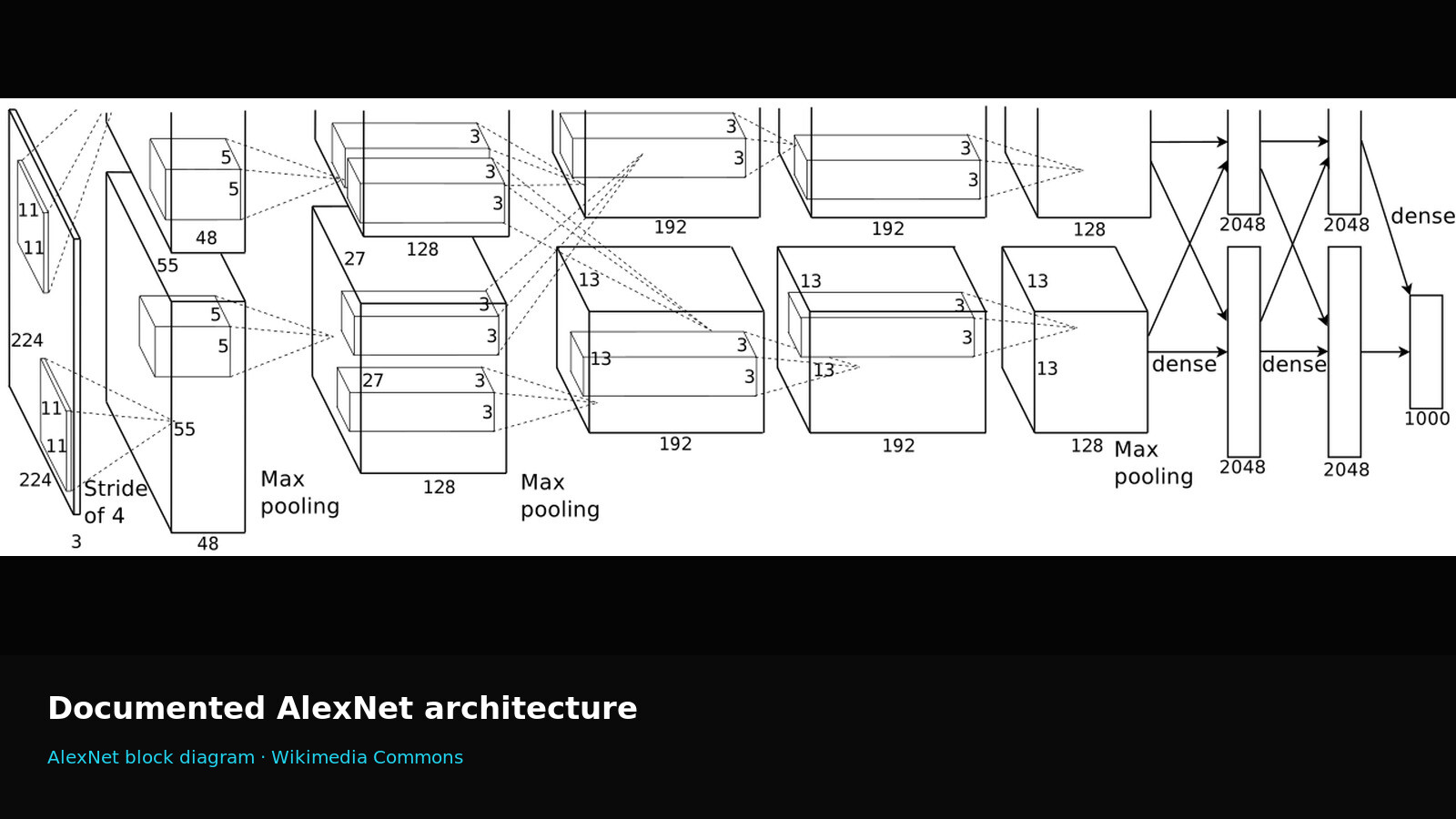
2009–2012: data, graphics chips and deep learning meet
The ImageNet project introduced a large, human-annotated image database organised into thousands of categories. Its 2009 paper described 3.2 million images across 5,247 categories, with plans to grow further.[10]
ImageNet gave computer-vision researchers a large training resource and a shared benchmark. In 2012, Alex Krizhevsky, Ilya Sutskever and Geoffrey Hinton entered a deep convolutional neural network in the ImageNet competition. The system, later known as AlexNet, achieved a top-five test error rate of 15.3%, compared with 26.2% for the second-best entry.[11]
The team trained the network on graphics processing units, or GPUs. Chips built to perform many calculations for computer graphics turned out to be well suited to the large amount of parallel arithmetic used in neural-network training.[11]
Why did it matter?
AlexNet did not invent neural networks, convolutional networks, GPUs or ImageNet. It demonstrated what happened when several ingredients finally met: a deep model, a large labelled dataset, enough computing power and practical training techniques.
The result helped move deep learning to the centre of AI research and industry.
In plain English: old ideas became much more effective when they gained enough data and computing power.

2016: AlphaGo defeats Lee Sedol
Go was much harder for computers to search than chess because each position offered so many possible moves. AlphaGo reduced that problem by combining deep neural networks with tree search. It learned from expert games and improved through games played against itself.[12]
In 2016, AlphaGo defeated Lee Sedol, one of the world’s leading Go players, by four games to one.
AlphaGo was still a specialist system. It could not take the abilities used for Go and apply them to an unrelated job. The result mattered because the methods combined learning, prediction, search and self-play in a problem many experts had expected to resist machines for longer.
Why did it matter?
Deep Blue relied heavily on fast search and human chess knowledge. AlphaGo showed a stronger role for learned representations and reinforcement learning.
The machine was not merely checking every possible future. It was learning which moves and positions were worth examining.
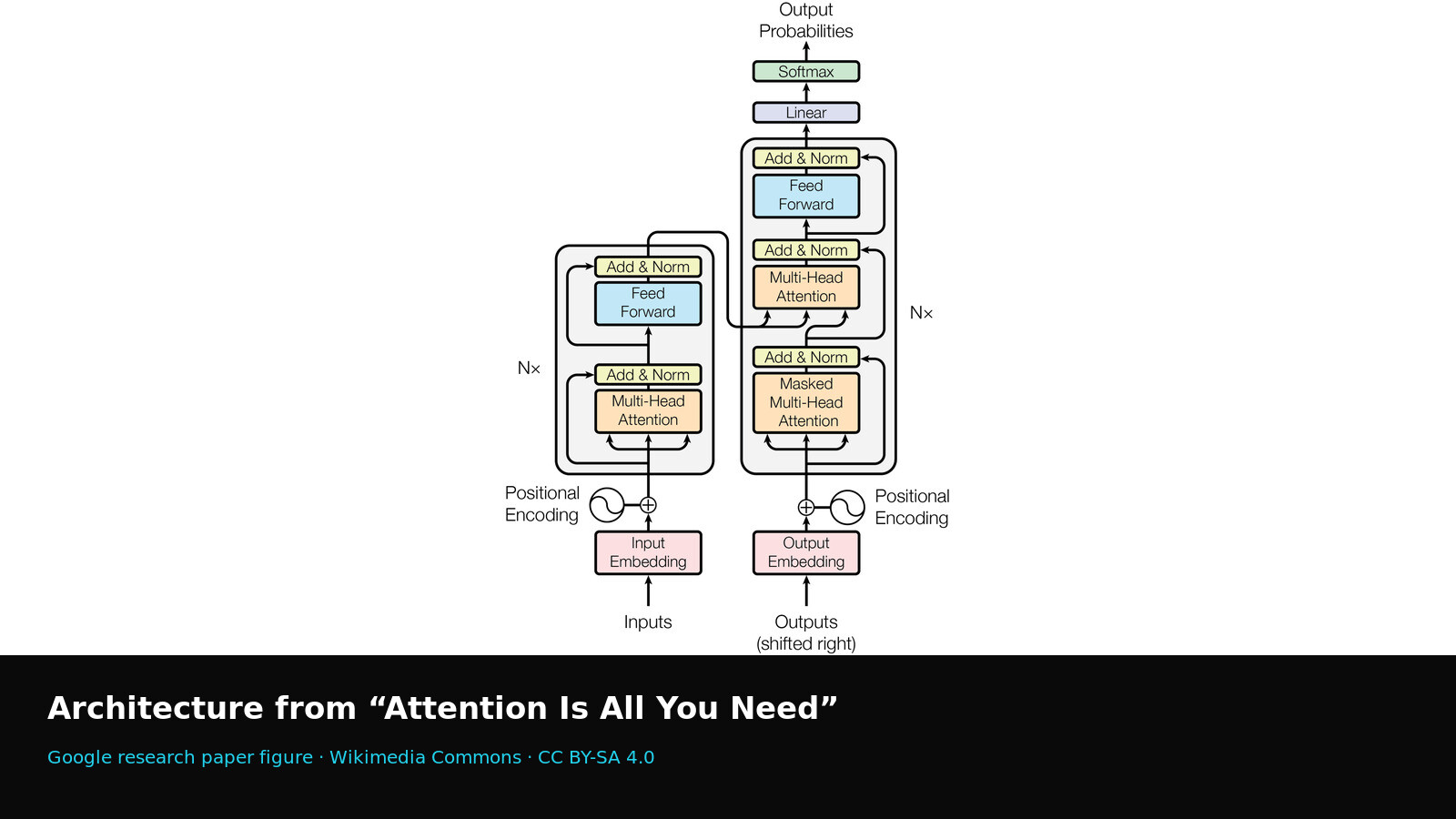
2017: the Transformer changes language AI
A team of researchers introduced a neural-network architecture called the Transformer in the paper Attention Is All You Need.[13]
Earlier language systems often processed a sequence step by step. The Transformer relied on attention mechanisms that let the model weigh relationships between different parts of the input. Its design also allowed more of the training work to happen in parallel.[13]
The original paper focused on machine translation. It did not introduce ChatGPT or prove that Transformers could do every language task.
Why did it matter?
Transformers scaled well with large datasets and powerful hardware. They became the main architecture behind a new generation of language models and many systems that work with images, audio and other data.
A model could now be trained on a broad body of material and then use the patterns it learned across many different prompts.
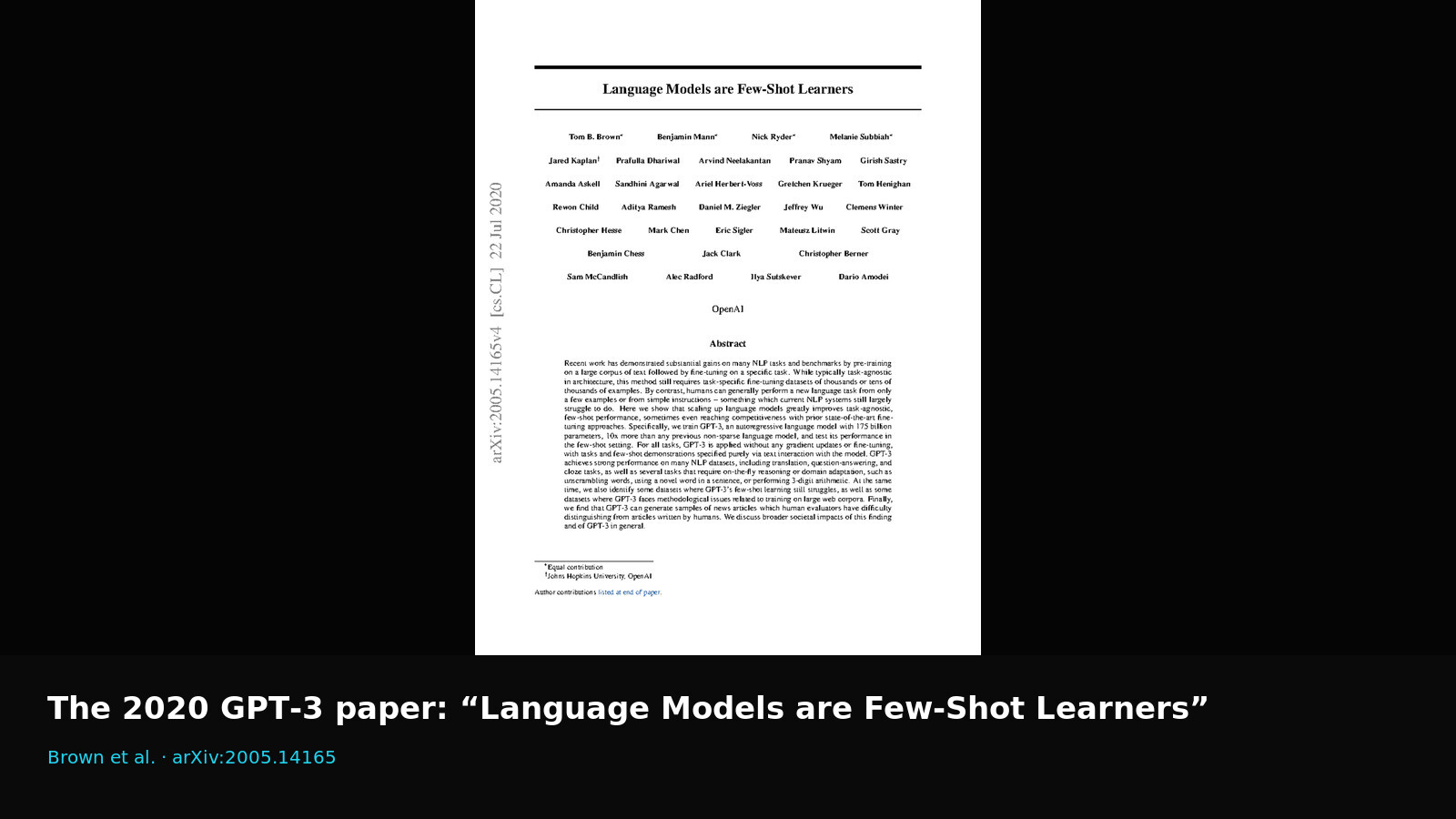
2020: GPT-3 shows the power and limits of scale
OpenAI’s GPT-3 was an autoregressive Transformer language model with 175 billion parameters. Researchers tested whether it could perform new tasks from instructions or a small number of examples written directly in the prompt, without task-specific updates to the model.[15]
It produced strong results on several language tasks, but the paper also documented weaknesses, including poor results on some datasets, bias, misuse risks and problems caused by training on large collections of online text.[15]
Why did it matter?
GPT-3 made prompting feel like a new way to program. Instead of retraining a separate model for every task, a user could describe the task in ordinary language and sometimes get a useful result.
Scale improved the range of behaviours, but it did not turn text prediction into guaranteed truth. A language model generates a likely continuation. That continuation can be fluent and still be wrong.
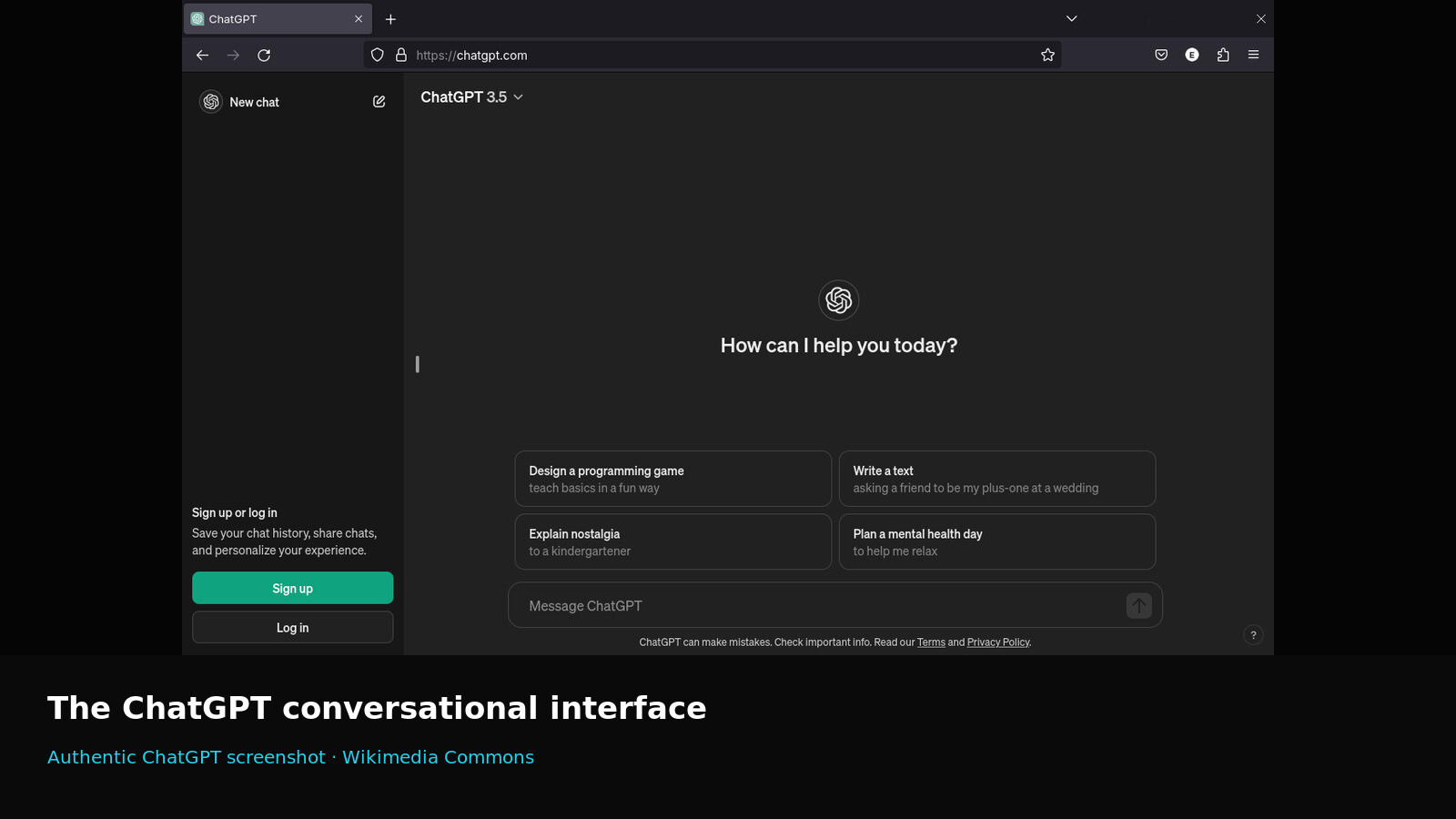
2022: ChatGPT takes AI to the public
OpenAI released ChatGPT as a research preview on 30 November 2022. It used a conversational interface and had been trained with human feedback so it could follow instructions and respond across multiple turns.[14]
OpenAI’s launch page openly listed problems. ChatGPT could write plausible but incorrect answers, change its answer after small changes in wording and guess what a user meant instead of asking for clarification.[14]
Chatbots and large language models existed before ChatGPT. The release mattered because the interface was easy to use. People did not need to write code or understand machine learning. They could type a request and continue the conversation.
Why did it matter?
ChatGPT brought generative AI into ordinary life on a much larger scale.
Millions of people could now experience both sides of generative AI directly: the surprising usefulness and the confident mistakes.
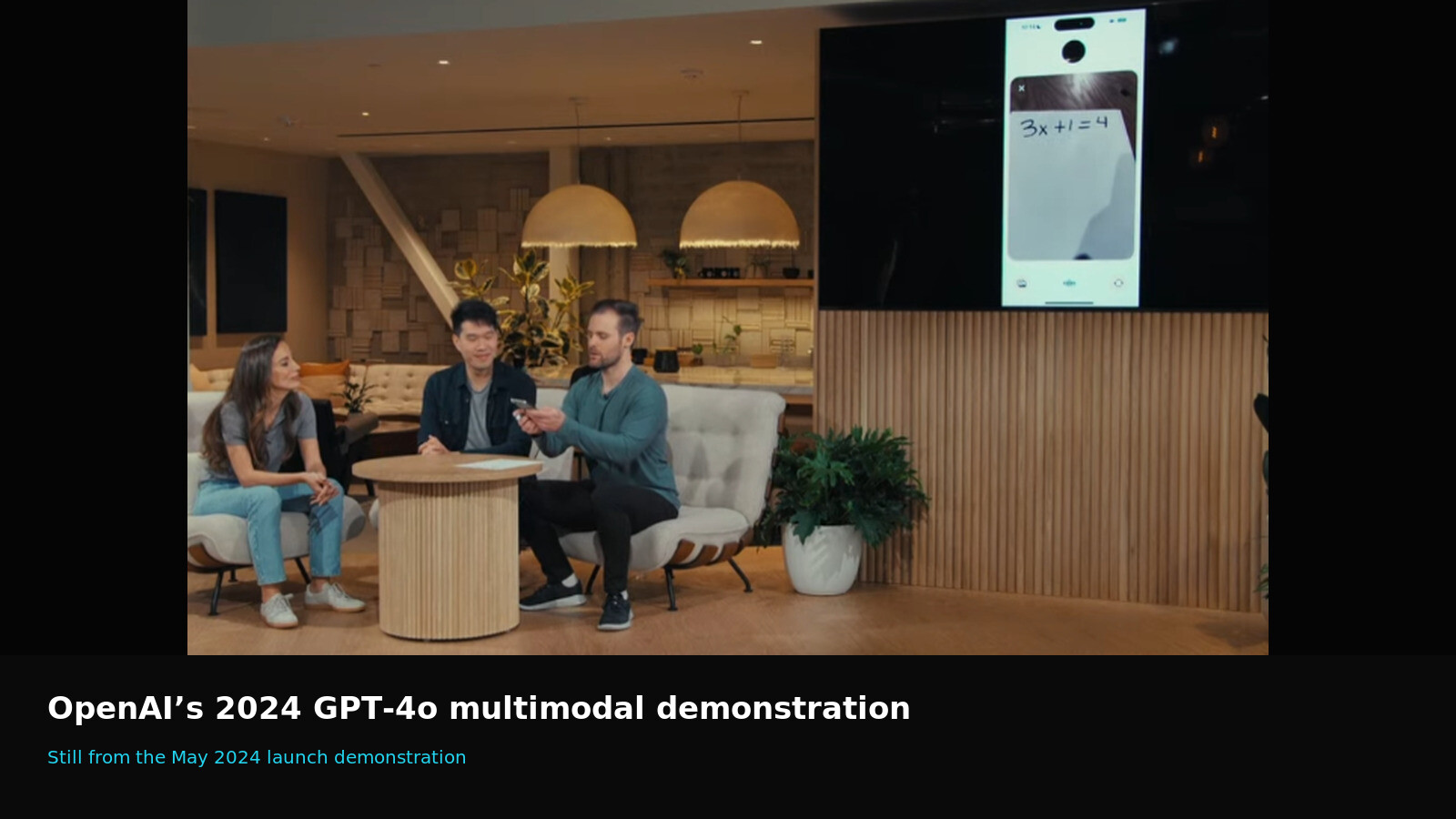
2024 onwards: AI gains more senses and starts using tools
Modern systems increasingly work across more than text. GPT-4o, released in 2024, was designed to process combinations of text, audio, images and video, with outputs across text, audio and images.[16] Its capabilities were released in stages: text and image features began rolling out first, while newer voice, audio and video capabilities followed separately.[16] Other companies and research groups have developed their own multimodal systems.
A second direction is the AI agent. There is no single agreed definition, but one useful distinction is whether the model directs how the task is carried out. Anthropic distinguishes fixed workflows, where code determines the route, from agents, where the model dynamically chooses its own steps and tool use.[17]
This direction is still developing. Tool access does not remove hallucinations or guarantee that a plan is sensible. An agent can make a wrong decision and then act on it, which makes permissions, checking and human oversight more important.
Why does it matter?
The interface is moving from “give me an answer” towards “help me complete the task.”
That does not mean a fully autonomous machine mind has arrived. Most useful systems still depend on human goals, human-created data, software tools, safety limits and somebody checking the result.
What the history of AI teaches us
AI is a collection of methods, not one creature
Logic Theorist, the perceptron, Deep Blue and ChatGPT were all called AI. They worked in very different ways and solved very different problems.
Asking whether “AI” can do something is often too vague. A better question is: which system, trained on what data, with which tools, under what conditions?
A narrow victory is not general intelligence
A machine can be superhuman at chess or Go and useless at making tea. It can produce an excellent paragraph and then invent a source.
Performance does not transfer automatically from one task to another.
Hype and disappointment repeat
AI has gone through more than one boom and more than one winter. New demonstrations attract money and ambitious predictions. Difficult real-world cases then reveal limits that the demonstration hid.
The useful work often survives after the excitement drops.
Better AI came from more than better algorithms
The modern boom depended on old ideas, larger datasets, faster chips, internet-scale computing, improved training methods and large numbers of people labelling, filtering and evaluating data.
There was no single moment when somebody “invented modern AI.” Many parts had to arrive together.
Fluent is not the same as truthful
ELIZA showed that people can feel understood by a simple conversational program. ChatGPT showed how much more convincing that experience becomes when the model can generate flexible language.
The lesson is not that the systems are useless. It is that the quality of the conversation can be mistaken for knowledge, intention or consciousness.
Where the story stands
AI has travelled from simplified mathematical neurons to systems that can discuss an image, generate music, write software and operate digital tools.
That is real progress. It is also unfinished.
Today’s systems can be remarkably capable and strangely unreliable in the same conversation. They reflect patterns in human-created data, but they do not automatically share human judgement, experience or responsibility.
The history helps because it removes the magic. AI is not one sudden invention and it is not a straight march towards a machine person. It is a long series of attempts to turn parts of intelligence into something a computer can perform.
Some attempts failed. Some worked in narrow settings. Some became ordinary technology and stopped feeling like AI at all.
The next chapter will probably contain the same mixture as the earlier ones: useful tools, overconfident predictions, unexpected breakthroughs and limits that only become obvious after millions of people start using the systems.
Sources
- Turing, Computing Machinery and Intelligence (1950)
- Dartmouth Summer Research Project proposal
- John McCarthy on the Dartmouth project
- Computer History Museum — John McCarthy
- SRI — Shakey the robot
- Lighthill report (1973)
- AAAI on AI winters and expert systems
- Rumelhart, Hinton and Williams, Nature (1986)
- IBM — Deep Blue
- ImageNet CVPR 2009 paper
- AlexNet, NeurIPS 2012
- AlphaGo, Nature (2016)
- Attention Is All You Need (2017)
- OpenAI — introducing ChatGPT
- Language Models are Few-Shot Learners (GPT-3)
- OpenAI — Hello GPT-4o
- Anthropic — Building effective agents
- McCulloch and Pitts (1943)
- Computer History Museum timeline — 1955
- Smithsonian — Mark I Perceptron
- Weizenbaum, ELIZA (1966)
Quick check
Three questions. No score stored on a server. It stays on this computer.
Also: